

#1. Introduction
In this blog post, I will walk you through how to humanize AI-generated content into human-like content that reads naturally and feels genuinely written.
You can spot raw AI writing from a mile away. It sounds neat, structured, and… strangely lifeless. The grammar is perfect, yet something feels missing. No warmth, personality and human touch.
That is the gap many writers, researchers, and creators are trying to bridge today.
The AI model can generate content fast, but readers still connect with stories, tone, and authenticity. If your content feels robotic, it would not engage even if it is technically correct.
#2. What is AI-Generated Content and Why Humanization Matters
AI-generated content is text created using tools like ChatGPT, Claude, or other AI writing tools. These systems analyze patterns in language and produce content based on prompts.
It is efficient, saves time, and can even sound impressive. But here is the issue.
Most AI content follows predictable structures. It often lacks emotional depth, personal insight, and natural variation. That is why humanization becomes essential.
Humanizing AI content means refining it so it feels like it came from a real person with voice, nuance, and intention.
And honestly, that is what readers trust.
#3. The Problem with Raw AI Generated Text
Let us be real for a moment. Raw AI output has some serious limitations.
1. It Sounds Robotic
Even when the sentences are correct, they feel repetitive. The tone stays flat. There is little rhythm or personality.
2. AI Detection Risks
Many platforms now use AI detection tools. Content that feels too structured or predictable can get flagged.
3. Surface-Level Insight
In many cases, AI provides answers that feel broad rather than specific. It rarely adds lived experience or original perspective.
4. Hidden Plagiarism Concerns
While AI does not copy directly, it may generate content that feels too similar to existing sources. That is risky for academic and professional writing.
So yes, AI helps but it can not replace human thinking.
5. AI Hallucination Issues
Sometimes AI presents information that sounds confident but isn’t accurate. It may invent facts, references, or data without warning.
This is known as hallucination. In academic and research writing, this can be dangerous because incorrect, false, made up and fabricated information may go unnoticed if not carefully verified.
6. AI Bias in Content
Data used to train AI models is often large in scale and may carry inherent biases. As a result, AI-generated content can unintentionally reflect cultural, social, or informational bias. This can affect fairness, accuracy, and balance, especially in academic or sensitive topics.
7. Lack of Context Awareness
The responses generated by AI may lack deeper contextual understanding. It may not fully understand the purpose, audience, or nuance behind the content. This can make the message feel slightly misaligned.
8. Overuse of Generic Phrases
AI tends to rely on safe and commonly used expressions. The writing may sound correct, but it often lacks originality and uniqueness.
Example: “Streamline processes…”
AI-style:
“AI helps streamline business processes.”
Human-like:
“AI helps simplify everyday tasks in business.”
9. Weak Argument Development
In academic writing, AI may present ideas without strong reasoning or supporting evidence. It explains, but does not always persuade.
10. Inconsistent Tone
The tone may shift within the same piece. One section can feel formal, while another feels casual. This inconsistency affects readability.
11. Lack of Emotional Connection
AI struggles to create emotional depth. It can explain ideas, but it rarely connects with readers on a personal level.
12. Poor Fact Verification
AI predicts text based on patterns rather than verified knowledge. This means it can present outdated or incorrect information without warning.
13. Redundancy and Repetition
AI often repeats ideas in slightly different ways. This increases length without adding real value.
14. Limited Creativity and Original Thought
AI recombines existing patterns. It rarely produces truly novel insights or fresh perspectives.
15. Lack of Audience Targeting
AI does not always adapt well to specific audiences such as researchers, students, or professionals. The content may feel too general.
16. Over-Structured Writing Style
AI tends to follow predictable formats. While organized, the writing can feel rigid rather than natural.
17. Weak Transitions Between Ideas
The flow between sections may feel abrupt. Instead of guiding the reader smoothly, AI sometimes jumps from one idea to another.
18. Overuse of Em Dashes
AI-generated content often relies too heavily on em dashes like this “—” to connect ideas. While useful in moderation, overuse makes writing feel artificial and formulaic instead of natural.
So yes, AI helps but it can’t replace human thinking.
In my earlier blogpost , I explored how AI tools can be used in academic writing.
#4. Practical Tips to Make AI Generated Content Feel Human
Now let’s get into what actually works.
Vary Sentence Length
Mix short and long sentences. It creates rhythm and keeps readers engaged.
Use Natural Transitions
Instead of rigid connectors, use softer transitions like “here’s the thing” or “let’s look at it this way.”
Add Micro-Stories
Even a quick example can bring content to life.
For instance, instead of saying:
“AI improves writing efficiency”
You could say:
“I once drafted a 1,500-word article in under 10 minutes using AI. Editing it took longer but the base was done.”
That feels real.
Adjust Tone Based on Audience
Academic writing needs clarity. Blogs need personality. LinkedIn needs authority with relatability.
Replace Generic Words and Paraphrase
AI often uses safe, generic phrases. Swap them with more specific language.
Read It Out Loud
If it sounds awkward when spoken, it probably needs editing.
#5. Step-by-Step Workflow to Humanize AI Generated Content
Here’s a simple workflow I personally recommend.
Step 1: Generate the Draft
Use AI to create a rough version. Don’t aim for perfection.
Step 2: Edit the Structure of AI Generated Content
Break long paragraphs. Rearrange sections for better flow.
Step 3: Add Your Voice
Insert opinions, examples, or personal insights.
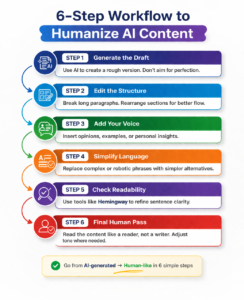
Step 4: Simplify Language
Replace complex or robotic phrases with simpler alternatives.
Step 5: Check Readability
Use tools like Hemingway to refine sentence clarity.
Step 6: Final Human Pass
Read the content like a reader, not a writer. Adjust tone where needed.
This final step matters the most.
#6. Best Prompts to Humanize AI Generated Content
Your output depends heavily on your prompt. A good prompt can transform the entire tone.
Prompt #1: Natural Rewrite
“Rewrite this content in a natural, human-like tone. Make it conversational, engaging, and less structured.”
Prompt #2: Academic Humanization
“Rewrite this academic paragraph to sound more human, clear, and original while maintaining accuracy.”
Prompt #3: Add Personality
“Rewrite this content with slight personality and variation in sentence structure. Avoid robotic tone.”
Prompt #4: Reduce AI Detection
“Make this content less predictable, more natural, and human-like without changing the meaning.”
Example :
Original AI Output:
“The results indicate a significant improvement in model performance.”
Humanized Version:
“What stood out in the results was a clear improvement in how the model performed.”
Same meaning. Better tone.
Common Mistakes to Avoid
Even experienced writers make these mistakes.
Over-Editing
Trying too hard to sound human can make writing messy. Over-editing often removes clarity and makes sentences feel forced rather than natural.
Blindly Trusting Tools
Tools help, but they don’t understand context like humans do. Relying only on tools can lead to awkward phrasing or incorrect tone.
Keeping AI Structure Intact
If the structure feels mechanical, rewrite it. A human reader should not feel the pattern behind the writing.
Ignoring Audience
A blog reader and a journal reviewer expect different tones. Writing without considering the audience reduces impact and engagement.
Chasing AI Detection Too Much
Focus on quality first. Natural writing often passes detection anyway. If you write only to “beat detection,” you may lose clarity, purpose, and authenticity in the process.