
Introduction: The Rise of AI in Academic Research
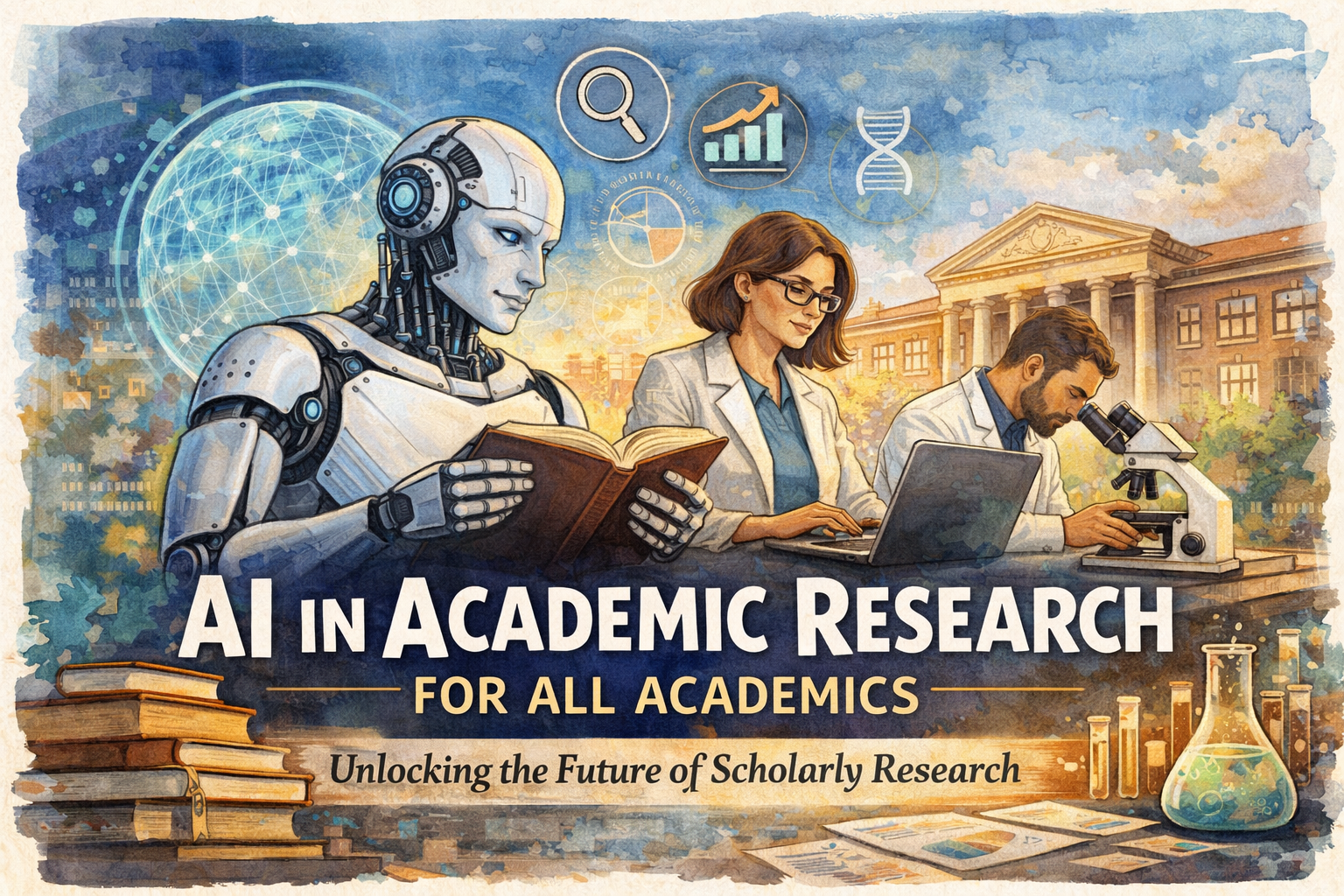
In this blog, I am going to explore AI in academic research and present the ultimate guide for every scholar to work smarter and publish faster. Artificial Intelligence (AI) has emerged as a transformative force in academic research, reshaping how knowledge is discovered, analyzed, and communicated. Over the past two decades, the research landscape has evolved from manual literature searches and labor-intensive data analysis to a more intelligent, automated, and interconnected ecosystem.
Today, AI is no longer confined to computer science laboratories; it is accessible to scholars across all disciplines, including humanities, social sciences, agriculture, medicine, and engineering. The integration of AI into academic workflows is not merely a technological upgrade but a paradigm shift that is redefining the very nature of research.
Why AI is Essential for Every Academic
AI has become an indispensable tool for modern researchers because it enhances productivity while preserving intellectual creativity. Rather than replacing human expertise, AI acts as an intelligent assistant that supports decision-making, reduces repetitive workload, and accelerates the research process.
Academics can now focus more on critical thinking and innovation while delegating routine tasks such as data sorting, formatting, and initial drafting to AI systems. This shift enables researchers to achieve higher efficiency without compromising the depth and quality of their work, making AI a crucial component of contemporary academic practice.
Transforming Literature Review with AI
One of the most time-consuming aspects of academic research is conducting a comprehensive literature review. AI-powered tools have revolutionized this process by enabling researchers to scan, summarize, and synthesize vast amounts of scholarly content within minutes.
Instead of manually reviewing hundreds of papers, academics can now identify key themes, research gaps, and influential studies more efficiently. AI also helps in uncovering emerging trends and interdisciplinary connections that may otherwise remain unnoticed, thereby enhancing the depth and scope of literature reviews. In my previous blog, “Free AI Research Assistant for Literature Reviews and Gap Analysis,” I explored AI-powered methods for literature review.
Enhancing Academic Writing and Communication
Academic writing often demands clarity, precision, and adherence to formal standards, which can be challenging for many researchers. AI tools assist in drafting, refining, and editing scholarly content, ensuring grammatical accuracy and coherent structure.
These tools can transform rough ideas into well-organized paragraphs, suggest improvements in tone and style, and even help in generating abstracts and summaries. However, it is important to recognize that AI should complement human intellect rather than replace it. The originality of ideas and critical insights must always originate from the researcher.
AI in Research Design and Methodology
AI is increasingly playing a vital role in shaping research design and methodology. It can assist academics in formulating research questions, selecting appropriate methodologies, and designing experiments or surveys.

By analyzing existing studies and datasets, AI can recommend methodological frameworks that align with the research objectives. This capability is particularly beneficial for early-career researchers who may require guidance in structuring their studies, as well as for experienced scholars exploring new interdisciplinary domains.
Data Analysis and Visualization with AI
The ability to analyze large and complex datasets is one of the most powerful applications of AI in academic research. AI-driven tools can identify patterns, generate predictive models, and create insightful visualizations that enhance data interpretation.
Researchers working with quantitative data can leverage AI to perform advanced statistical analyses, while those dealing with qualitative data can use AI for text mining and sentiment analysis. This not only improves accuracy but also enables researchers to derive meaningful insights that contribute to evidence-based conclusions.
Advanced AI Applications in Research
For researchers in technical and scientific fields, AI offers advanced capabilities such as machine learning, natural language processing, and graph-based modeling. These technologies enable the development of sophisticated models that can simulate real-world scenarios, predict outcomes, and uncover hidden relationships within data.
As for example, in agriculture, AI can be used to optimize crop yield and monitor environmental conditions, while in healthcare, it can assist in disease diagnosis and treatment planning. Such applications highlight the versatility and potential of AI across diverse research domains.
Ethical Considerations and Challenges
Despite its numerous advantages, the use of AI in academic research raises important ethical concerns. Issues such as data privacy, algorithmic bias, and AI-generated inaccuracies must be carefully addressed.
Researchers must remain vigilant about the reliability of AI outputs and ensure that all generated content is critically evaluated and verified. Additionally, maintaining academic integrity is essential, as over-reliance on AI without proper attribution can lead to ethical violations. Responsible use of AI requires a balance between technological convenience and scholarly rigor.
Best Practices for Using AI in Research
To maximize the benefits of AI, academics should adopt a thoughtful and strategic approach. It is essential to use AI as a supportive tool rather than a substitute for intellectual effort.
You should verify all AI-generated information, maintain originality in their work, and ensure proper citation of sources. Understanding the limitations of AI systems is equally important, as it helps in avoiding potential errors and biases. By following these best practices, you can harness the full potential of AI while maintaining the integrity of their research.
The Future of AI in Academic Research
The future of academic research is closely intertwined with the advancement of AI technologies. As AI continues to evolve, it is expected to play an even greater role in hypothesis generation, collaborative research, and real-time data analysis.
The integration of AI into research workflows will lead to more efficient knowledge creation and dissemination, ultimately contributing to the advancement of science and society. Academics who embrace AI will be better equipped to navigate this rapidly changing landscape and achieve greater impact in their respective fields.
Conclusion: Embracing AI as a Research Companion
AI is not a replacement for human intelligence but a powerful companion that enhances the research journey. It empowers academics to work more efficiently, explore new ideas, and overcome traditional limitations.
By adopting AI responsibly and ethically, researchers can unlock new possibilities and drive innovation across disciplines. The key lies in understanding that AI is a tool one that, when used wisely, can transform the future of academic research for all.